Showing posts with label Joiner History Room. Show all posts

Monday, March 21, 2022

Lecture Series Presents “Exploring Jacob Haish”

DeKALB – In 1875, Jacob Haish secured a patent for his “S Barb” wire design, claiming his spot as one of DeKalb’s “Barbed Wire Barons,” and a role in the development of the west.

While mostly known for his contribution to the barbed wire industry, Haish also patented and manufactured farming implements and was a banker. He left most of his fortune to the city of DeKalb, resulting in the public library and much more.

On Thursday, April 7, Jessi Haish LaRue, a Haish family descendant, will present and discuss “new” artifacts and research related to this lesser-known barbed wire entrepreneur. LaRue has been researching in the Joiner History Room since fall 2021 in an effort to make Haish-related items more accessible to the public and creating conversation regarding Haish’s impact.

The lecture, titled “Adventures in Research: Exploring Jacob Haish,” is part of Brown Bag Lunch/Local Lore, a collaboration between the Ellwood House Museum and DeKalb County History Center. 

The free one-hour program will take place at noon at the DeKalb County History Center, 1730 N. Main Street in Sycamore. A virtual option is also available. To register, visit dekalbcountyhistory.org. 

Brown Bag Lunch/Local Lore is funded in part by the Mary E. Stevens Concert and Lecture Fund.

Sunday, January 30, 2022

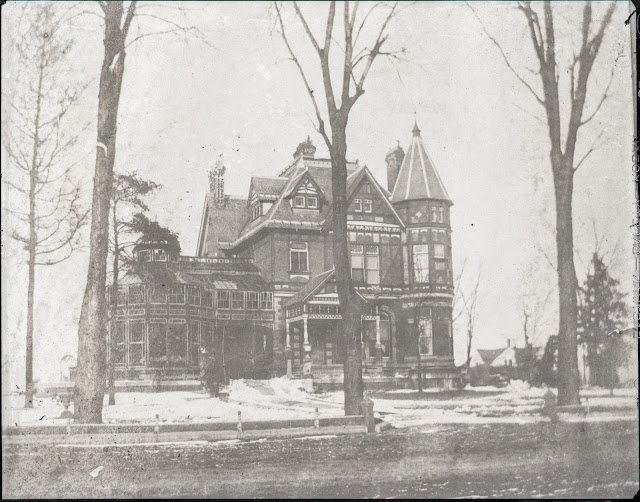
A unique view of the Haish mansion

Jacob Haish mansion in DeKalb, date unknown | Courtesy of the DeKalb County History Center Archives

I was thrilled to find this image in the Joiner History Room archives. I wasn't entirely sure what I was seeing at first, as this only existed in a negative format. With help from Rob Glover, director of Joiner History Room, we were able to digitally process this image so that others can enjoy it as well. Much better than holding a negative up to a light and squinting at it.

This image is wonderful because it gives us a unique view of the mansion; we typically see it from the corner of Third and Pine Streets, and in most of those images, we also see the Haish carriage house next door. This angle, taken from Pine Street, allows us to see a side of the Haish mansion that is not as familiar. From this direction, the carriage house would be directly "behind" the mansion. The house was demolished in 1961.

To scroll through my previous posts and photos regarding the Haish mansion, click here.

Sunday, January 16, 2022

Unearthing "new" Jacob Haish items locally

This article was originally published in the winter 2021 edition of Cornsilk magazine.

- - -

I've been getting to know my uncle, two days a week, almost 100 years after his death.


Last fall, Rob Glover, Director of the Joiner History Room, invited me to explore the Joiner History Room archives for any Jacob Haish related items. I've been blogging about Haish, my fourth-great uncle, for almost six years now, and it was just assumed that I had seen most of the local archival items. After all, how much can really remain on a man who had no heirs and his house no longer stands?


I had so much to learn.


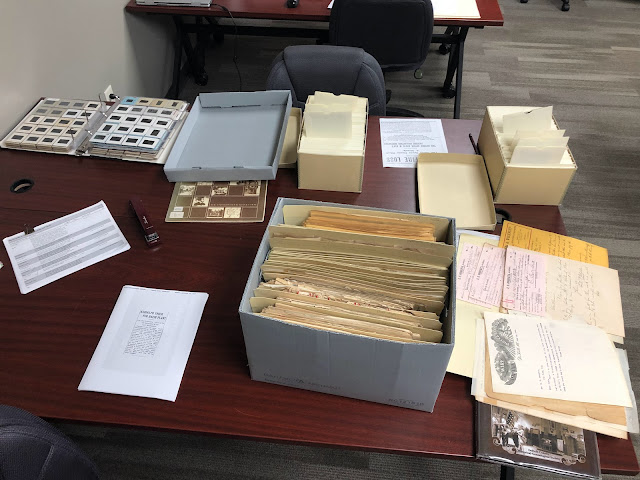
Starting the process was simple enough. Rob did a very generic search for "Haish" in the Past Perfect collection database and printed out a list that was 36 pages long. We've been working through the list for weeks now; I notate a few interesting items for each visit and Rob pulls boxes from the archives. Then I dig through files and folders like a child opening presents on Christmas morning.


Some items are surprising; I couldn't believe that the last few monetary checks from the Jacob Haish Estate were saved! Others are things I'd seen before, like a photocopy of that photo of Jacob Haish, the one everyone recognizes and is immortalized in a painting at Northern Illinois University. I've also seen items that I never even knew existed. I have audibly gasped, laughed, and said "wow!" as something "new," well, new to me, is unearthed.


As we continue to pull countless items related to Haish and his many ventures, such as barbed wire, farm implements, banking and more, I am truly stunned at how much wonderful history has remained local, and right in my "backyard" at the DeKalb County History Center. Better yet, these were items saved by someone who found them important, and they made sure they found their way to the Joiner History Room. For that, we are so lucky.


These are just a few unique items that have been "rediscovered." As I continue to research and learn more about items, they will be posted on my blog at JacobHaishStory.com.


"Haish" pins

Two pins that simply say "Haish," with no more archival documentation other than their color and dimensions, these baffle me. Which Haish had them made? Was it Jacob? Did a relative run for political office? Perhaps a school spirit pin for the former Haish School in DeKalb? Much to my disappointment, my research and pleas for help on Facebook have continually come up short. 


---

Jacob Haish's signature

In my time researching Haish, there has been this odd, almost urban legend story surrounding him: that he was illiterate. Multiple sources have relayed to me that because of his immigrant status, arriving in the United States from Germany when he was 9 years old, that he could not read, write, or even sign his own name. That myth seems to be debunked, as multiple documents in the Joiner archives show Haish's signature. Two of the most legible and interesting instances are when he signed his name in pencil on lined sheets of paper; they were petitions encouraging school board ventures. He was a staunch supporter of schools and libraries in DeKalb and beyond.


---


Sophia Haish calling cards

In a stack of calling cards from various but prominent DeKalb ladies, I saw one for "Mrs. Jacob Haish, DeKalb, Ills." Sophia's was the best quality of the bunch, printed on a thicker paper with intricate scalloped edging. 


Calling cards, or visiting cards, as they are sometimes called, were used to announce someone's arrival, or left as a message for those who were not at home. I imagined Sophia Haish appearing at a fellow DeKalbian's doorstep and presenting her card. I wondered about the conversations she would have had regarding both pleasure and business. I think she may have done quite a bit of business talk, as Jacob often included her in his ventures and she was even co-president of their Barb City Bank.


---


Whether you're exploring the history of your home, school, or in my case, a very distant relative, the Joiner History Room at the DeKalb County History Center is a great resource. And just when you start to think you've seen it all...you'll realize you've only cracked the tip of the iceberg. Call or stop by to start your research journey.

Wednesday, November 17, 2021

Unidentified Haish pins

I've been working my way through the Haish-related archives at the Joiner History Room, and have come across two unidentified pins that simply read "Haish." 

With no additional documentation, one can only make educated guesses about the history of these pins. Perhaps a Haish family member ran for public office? Who knows.

Below are photos of the pins, along with the only identifying information.


"1 inch triangle, red on one side and white on the other. Gold bar down center with 'Haish.'"


"1/2 inch button: red & white 'Haish'"

Thursday, November 12, 2020

Photograph of Jacob Haish

Rob Glover of the Joiner History Room shared this wonderful photograph of Jacob Haish with us. It's one I've never seen before, but what a great image! 

Courtesy of Joiner History Room

Friday, April 6, 2018

PHOTOS: Fire Destroys Haish Shop

Haish Spreader Factory Fire | Photo courtesy of Joiner History Room, DeKalb County Archives
We are continuing to share Jacob Haish-related images from the Floyd Ritzman Collection. The Joiner History Room has generously allowed me to share these images on this website.

These photos capture a fire that completely destroyed Jacob Haish's manure spreader factory in 1914. The May 20, 1914, edition of the Sycamore True Republican called the fire the "heaviest fire loss in the history of DeKalb." 

According to the article: "All of the contents of the big shops, which included some 200 completed manure spreaders, and a great amount of other products and raw materials, were completely destroyed." To read the complete article, click here.

Haish Spreader Factory Fire | Photo courtesy of Joiner History Room, DeKalb County Archives

Haish Spreader Factory Fire | Photo courtesy of Joiner History Room, DeKalb County Archives

Haish Spreader Factory Fire | Photo courtesy of Joiner History Room, DeKalb County Archives

Haish Spreader Factory Fire | Photo courtesy of Joiner History Room, DeKalb County Archives

Haish Spreader Factory Fire | Photo courtesy of Joiner History Room, DeKalb County Archives

Haish Spreader Factory Fire | Photo courtesy of Joiner History Room, DeKalb County Archives

Haish Spreader Factory Fire | Photo courtesy of Joiner History Room, DeKalb County Archives

Haish Spreader Factory Fire | Photo courtesy of Joiner History Room, DeKalb County Archives

Haish Spreader Factory Fire | Photo courtesy of Joiner History Room, DeKalb County Archives

- - -
From the Joiner History Room website: "Over 700 photos from the Floyd Ritzman Collection which are part of the Northern Illinois University Digital Library are now available on Flickr at https://flic.kr/s/aHskqwXroS. This collection of photos, taken in and around DeKalb County, was formerly part of the Taming the Wild Prairie website. Thanks to Matthew Short at NIU for making these historical photos available."

According to the Joiner History Room's website, "Floyd R. Ritzman (1885-1975) was a teacher and administrator in the DeKalb public school system. His passion was photography." Special thanks to the Joiner History Room for allowing me to share these images.

Monday, February 26, 2018

PHOTOS: Jacob Haish Mansion

We are continuing to share Jacob Haish-related images from the Floyd Ritzman Collection. The Joiner History Room has generously allowed me to share these images on this website.

The below photos capture the Jacob Haish mansion in all its glory, and later, at its demise.

Jacob Haish home in 1930 | Photo courtesy of Joiner History Room, DeKalb County Archives
Residence of Jacob Haish, 1901 | Photo courtesy of Joiner History Room, DeKalb County Archives
Jacob Haish home in 1941 | Photo courtesy of Joiner History Room, DeKalb County Archives
Haish house being razed in 1961 | Photo courtesy of Joiner History Room, DeKalb County Archives
From the Joiner History Room website: "Over 700 photos from the Floyd Ritzman Collection which are part of the Northern Illinois University Digital Library are now available on Flickr at https://flic.kr/s/aHskqwXroS. This collection of photos, taken in and around DeKalb County, was formerly part of the Taming the Wild Prairie website. Thanks to Matthew Short at NIU for making these historical photos available."

According to the Joiner History Room's website, "Floyd R. Ritzman (1885-1975) was a teacher and administrator in the DeKalb public school system. His passion was photography." Special thanks to the Joiner History Room for allowing me to share these images.

Friday, February 23, 2018

PHOTOS: Jacob Haish's employees

Over the next few blog posts, I will be sharing some incredible Jacob Haish-related images. These images are part of the Floyd Ritzman Collection, and the Joiner History Room has generously allowed me to share these images on this website.

The below photos capture some of the hardworking men "behind the scenes" in Jacob Haish's empire. Although they are not named, the faces of Haish's employees are captured below: the first photo shows some of his factory employees in 1910, and the second photo shows the engine room's work force in 1901.

Haish Factory Employees, 1910 | Photo courtesy of Joiner History Room, DeKalb County Archives
Work Force in Engine Room of Haish Plant, 1901 | Photo courtesy of Joiner History Room, DeKalb County Archives

From the Joiner History Room website: "Over 700 photos from the Floyd Ritzman Collection which are part of the Northern Illinois University Digital Library are now available on Flickr at https://flic.kr/s/aHskqwXroS. This collection of photos, taken in and around DeKalb County, was formerly part of the Taming the Wild Prairie website. Thanks to Matthew Short at NIU for making these historical photos available."

According to the Joiner History Room's website, "Floyd R. Ritzman (1885-1975) was a teacher and administrator in the DeKalb public school system. His passion was photography." To learn more about Ritzman, click here.

Special thanks to the Joiner History Room for allowing me to share these images. Stay tuned for more!

Saturday, November 5, 2016

Jacob Haish reflects on his donations

Jacob Haish | Photo courtesy of Joiner History Room
The article below was printed in the Dec. 5, 1885, edition of the Sycamore True Republican:
"That was a grandly liberal gift of yours --- that $50,000 to the Denver Orphan Asylum," --- we said to Mr. Haish of DeKalb.

"No, I don't know as it was. I have made more liberal gifts." 

"Ah! When?"

"Thirty years ago, when they were building the first church at DeKalb, I subscribed $30, and worked it out by day's work. That was more liberal than this. Then I gave what I hadn't got; now I give what I have, and can give it without troubling me. Why; how much did you ever give away at once?"

"Well, let's see; I gave $140 toward a church and lot."

"Ah, then, I venture to say you were three times as liberal as I was. I shall have to give again to be as liberal as some of my townspeople who give their tens and twenties. And I mean to do it. Wife and I have been thinking this long time that it is better to dispose of our property during our life-time while we can see some good of it than to wait for our successors to quarrel over it."

Perhaps we err in publishing this fragment of a private conversation, but there is something so noble about his unselfish view of the right use of his property that we could not refrain.
Thanks to the Joiner History Room for sharing this article.