Thursday, February 10, 2022

Haish's story featured in American West encyclopedia

The American West: A Multicultural Encyclopedia" features a section on Jacob Haish's history. In fact, he is the last entry in his particular volume, so he is even listed on the spine and on the index for all of the other titles in the series.

There are some factual errors in the description, such as his birth and death years, which I've corrected below. Even so, it's nice to see Haish considered a piece of stand-alone history.

"Haish, Jacob

182[6]-192[6]

Jacob Haish was an inventor and manufacturer, best known for devising and patenting the 'S' barbed wire.

Haish (b. Baden, Germany, on March 9, 1827) and his family immigrated to the United States when he was [nine] years old, ultimately settling in De Kalb County, Illinois. As a young man, after building a successful business as a contractor and lumber dealer in De Kalb, Haish began to experiment with barbed wire. However, when he tried to patent the result in 1873, he discovered that his townsman Joseph [F.] Glidden had applied for a similar patent only two months earlier. Although his challenge to Glidden's patent was unsuccessful, Haish persisted with his experiments until he developed the 'S' barbed wire, which he patented on August 31, 1875.

Haish's 'S' became the best-selling barbed wire in the West. Over the years, Haish continued to manufacture barbed wire and other products, including plain wire, nails, staples, and woven-wire fencing. He died on February 19, 1926, a few weeks before his 100th birthday."

Sunday, January 30, 2022

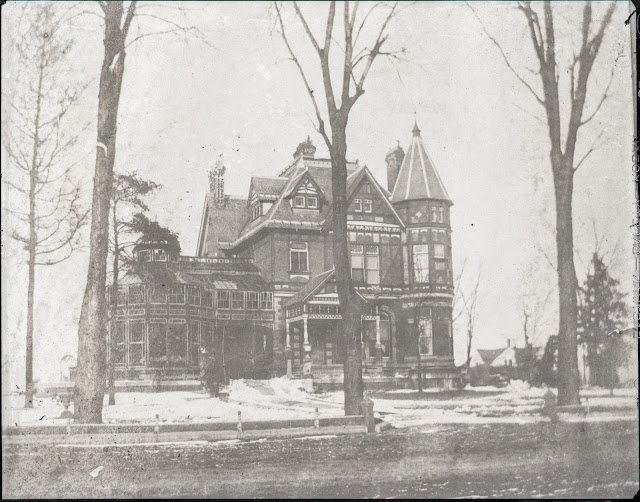
A unique view of the Haish mansion

Jacob Haish mansion in DeKalb, date unknown | Courtesy of the DeKalb County History Center Archives

I was thrilled to find this image in the Joiner History Room archives. I wasn't entirely sure what I was seeing at first, as this only existed in a negative format. With help from Rob Glover, director of Joiner History Room, we were able to digitally process this image so that others can enjoy it as well. Much better than holding a negative up to a light and squinting at it.

This image is wonderful because it gives us a unique view of the mansion; we typically see it from the corner of Third and Pine Streets, and in most of those images, we also see the Haish carriage house next door. This angle, taken from Pine Street, allows us to see a side of the Haish mansion that is not as familiar. From this direction, the carriage house would be directly "behind" the mansion. The house was demolished in 1961.

To scroll through my previous posts and photos regarding the Haish mansion, click here.

Sunday, January 16, 2022

Unearthing "new" Jacob Haish items locally

This article was originally published in the winter 2021 edition of Cornsilk magazine.

- - -

I've been getting to know my uncle, two days a week, almost 100 years after his death.


Last fall, Rob Glover, Director of the Joiner History Room, invited me to explore the Joiner History Room archives for any Jacob Haish related items. I've been blogging about Haish, my fourth-great uncle, for almost six years now, and it was just assumed that I had seen most of the local archival items. After all, how much can really remain on a man who had no heirs and his house no longer stands?


I had so much to learn.


Starting the process was simple enough. Rob did a very generic search for "Haish" in the Past Perfect collection database and printed out a list that was 36 pages long. We've been working through the list for weeks now; I notate a few interesting items for each visit and Rob pulls boxes from the archives. Then I dig through files and folders like a child opening presents on Christmas morning.


Some items are surprising; I couldn't believe that the last few monetary checks from the Jacob Haish Estate were saved! Others are things I'd seen before, like a photocopy of that photo of Jacob Haish, the one everyone recognizes and is immortalized in a painting at Northern Illinois University. I've also seen items that I never even knew existed. I have audibly gasped, laughed, and said "wow!" as something "new," well, new to me, is unearthed.


As we continue to pull countless items related to Haish and his many ventures, such as barbed wire, farm implements, banking and more, I am truly stunned at how much wonderful history has remained local, and right in my "backyard" at the DeKalb County History Center. Better yet, these were items saved by someone who found them important, and they made sure they found their way to the Joiner History Room. For that, we are so lucky.


These are just a few unique items that have been "rediscovered." As I continue to research and learn more about items, they will be posted on my blog at JacobHaishStory.com.


"Haish" pins

Two pins that simply say "Haish," with no more archival documentation other than their color and dimensions, these baffle me. Which Haish had them made? Was it Jacob? Did a relative run for political office? Perhaps a school spirit pin for the former Haish School in DeKalb? Much to my disappointment, my research and pleas for help on Facebook have continually come up short. 


---

Jacob Haish's signature

In my time researching Haish, there has been this odd, almost urban legend story surrounding him: that he was illiterate. Multiple sources have relayed to me that because of his immigrant status, arriving in the United States from Germany when he was 9 years old, that he could not read, write, or even sign his own name. That myth seems to be debunked, as multiple documents in the Joiner archives show Haish's signature. Two of the most legible and interesting instances are when he signed his name in pencil on lined sheets of paper; they were petitions encouraging school board ventures. He was a staunch supporter of schools and libraries in DeKalb and beyond.


---


Sophia Haish calling cards

In a stack of calling cards from various but prominent DeKalb ladies, I saw one for "Mrs. Jacob Haish, DeKalb, Ills." Sophia's was the best quality of the bunch, printed on a thicker paper with intricate scalloped edging. 


Calling cards, or visiting cards, as they are sometimes called, were used to announce someone's arrival, or left as a message for those who were not at home. I imagined Sophia Haish appearing at a fellow DeKalbian's doorstep and presenting her card. I wondered about the conversations she would have had regarding both pleasure and business. I think she may have done quite a bit of business talk, as Jacob often included her in his ventures and she was even co-president of their Barb City Bank.


---


Whether you're exploring the history of your home, school, or in my case, a very distant relative, the Joiner History Room at the DeKalb County History Center is a great resource. And just when you start to think you've seen it all...you'll realize you've only cracked the tip of the iceberg. Call or stop by to start your research journey.

Saturday, December 18, 2021

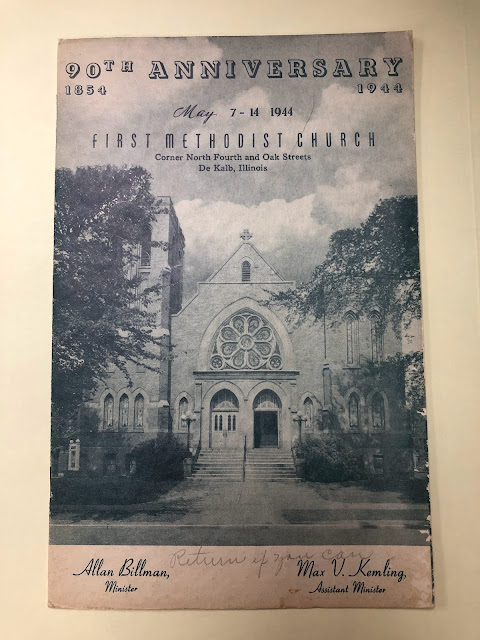
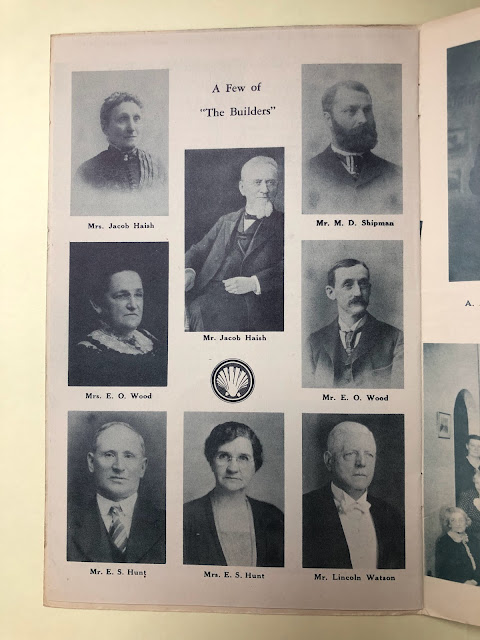
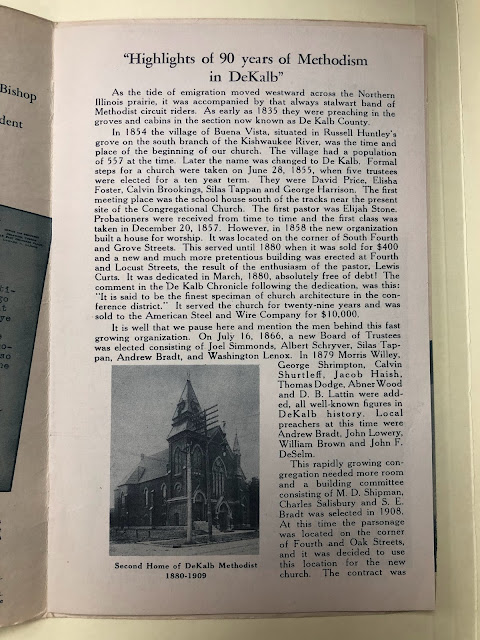
Haishes recognized by First Methodist Church

Cover of First Methodist Church's 90th anniversary booklet | Courtesy of DeKalb County History Center Archives
'The builders' of First Methodist Church | Courtesy of DeKalb County History Center Archives
Highlights of Methodism in DeKalb | Courtesy of DeKalb County History Center Archives

This informational program was printed by the First Methodist Church in DeKalb to celebrate its 90th anniversary in 1944.

Jacob and Sophia Haish's images make an appearance on a page titled "A Few of 'The Builders,'" which includes other DeKalb figures that helped create and maintain the historical church throughout its history.

The section "Highlights of 90 years of Methodism in DeKalb," tells the story of its start and mentions Haish's influence:

"It is well that we pause here and mention the men behind this fast growing organization. On July 16, 1866, a new Board of Trustees was elected consisting of Joel Simmonds, Albert Schryver, Silas Tappan, Andrew Bradt, and Washington Lenox. In 1879 Morris Wiley, George Shrimpton, Calvin Shurtleff, Jacob Haish, Thomas Dodge, Abner Wood and D.B. Lattin were added, all well-known figures in DeKalb History."

Monday, December 13, 2021

Merry Christmas from Haish School

Haish School class in 1960 | Courtesy of the DeKalb County History Center Archives

A Haish School class from 1960 holding cards that read "Merry Christmas."